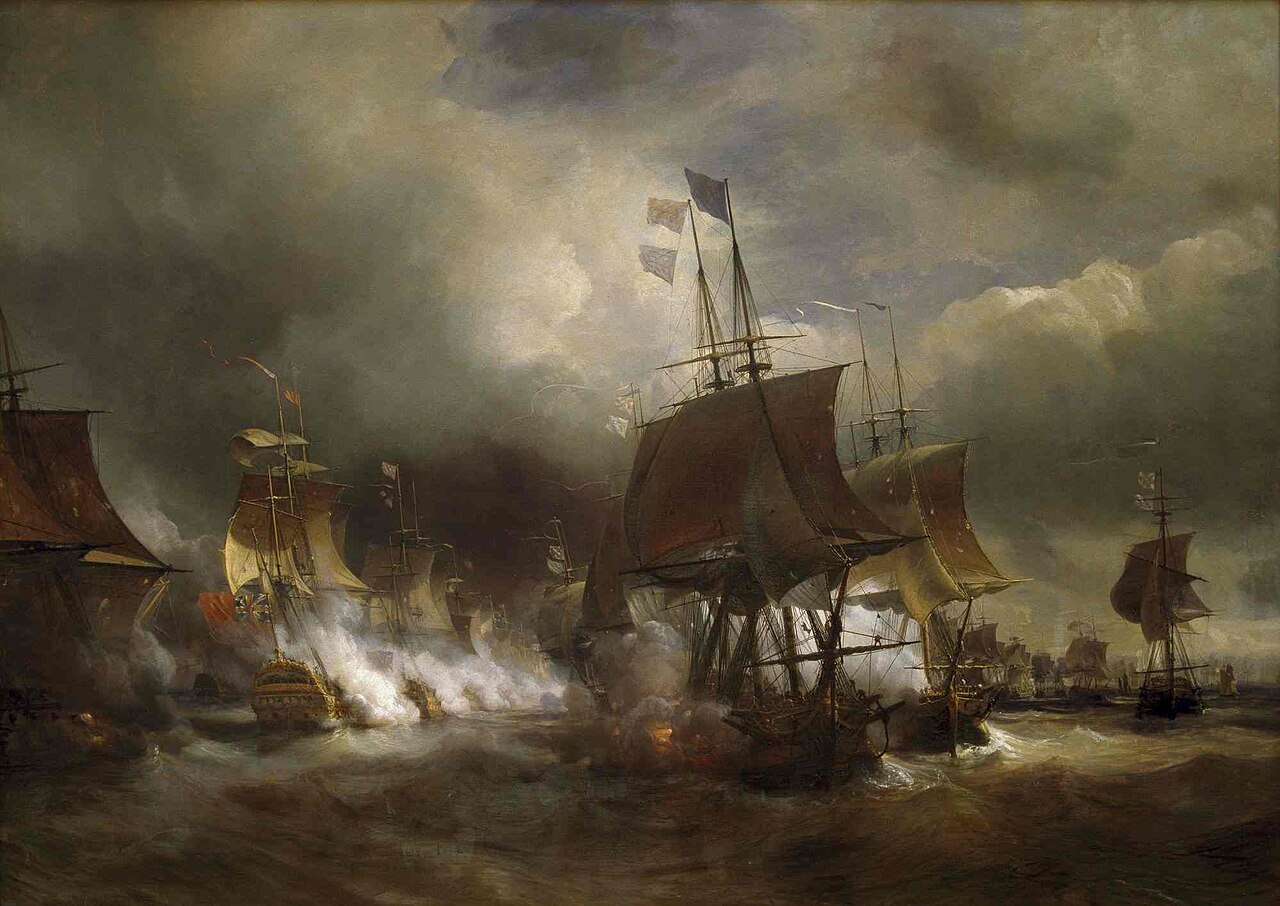
The Battle of Ushant: The French Ship Indien's Pivotal Role in 1778
The vast, tempestuous waters off Ushant island, near the northwestern tip of Brittany, became the stage for a crucial naval encounter on July 27, 1778. Known as the First Battle of Ushant, this clash represented the initial major fleet engagement between France and Great Britain during the American Revolutionary War. Amidst the grandeur and chaos of sail and cannon, a particular vessel stood out, not just for its presence but for its unique origins: the French ship
Indien. A 64-gun ship of the line, the
Indien embodied an innovative blend of commercial pragmatism and burgeoning naval power, a testament to France's strategic adaptation in a period of global conflict. Its participation in this inconclusive yet strategically vital battle underscores a fascinating chapter in maritime history, revealing the intricate dance between economics, shipbuilding, and warfare in the late 18th century.
The Birth of a Hybrid Warship: The Indien's Unique Origins
The story of the
Indien begins not in a traditional naval dockyard but with the ambitious commercial ventures of the Compagnie des Indes Orientales – the French East India Company. Conceived as the lead ship of her class, the
Indien was initially ordered in the late 1760s, a testament to the company's need for robust, self-defending merchantmen in an era fraught with piracy and privateering on lucrative trade routes. Designed by the esteemed naval architects Antoine Groignard and Gilles Cambry, she was launched on July 30, 1768, at the Lorient-Caudan shipyard.
Her design was a remarkable exercise in balancing utility. At approximately 157 feet 6 inches (51.2 meters) on the gun deck, with a beam of 43 feet 2 inches (13.2 meters) and a depth in hold of 17 feet 6 inches (5.5 meters), the
Indien was a substantial vessel. Her impressive displacement of 2,250 tonneaux and a burthen of 1,300 port tonneaux allowed for extensive cargo holds, vital for transporting the precious spices, textiles, and other goods from the East Indies. Simultaneously, her construction incorporated reinforced framing to withstand the rigours of tropical conditions and fierce storms, along with provisions for large crews accustomed to extended periods at sea. This architectural philosophy reflected a broader strategic shift: the recognition that heavily armed merchant vessels, capable of defending themselves against formidable threats, were essential for safeguarding invaluable colonial trade.
The
Indien's armament, as originally built, was formidable for a merchant vessel, comprising 64 guns: 26 powerful 24-pounders on the lower deck, 28 12-pounders on the upper deck, and 10 lighter 6-pounders distributed across the quarterdeck and forecastle. This configuration not only offered significant defensive capabilities but also paved the way for her eventual seamless transition into a full-fledged warship. For a deeper dive into this fascinating transformation, explore how the
Indien: French East India Company Ship to Naval Warship came to be.
From Merchant Service to Naval Power: The French Navy's Acquisition
The
Indien's destiny took a decisive turn in April 1770, not long after her launch. Facing mounting financial difficulties, the Compagnie des Indes Orientales was forced to divest its assets, including its impressive fleet of hybrid merchant-warships. The French Navy, keenly aware of the brewing geopolitical tensions that would soon erupt into the American Revolutionary War, seized the opportunity. Acquiring the
Indien and her sister ships, the Navy swiftly commissioned them for fleet duties, bolstering its ranks at a critical juncture.
Upon her naval commissioning, the
Indien's complement swelled to approximately 580 men in wartime, a clear indicator of her new role as an active combatant. Her career from 1770 to 1783 saw her primarily operating in the crucial Atlantic and Mediterranean theatres, contributing significantly to French naval efforts supporting the American cause. Integrated into the formidable Brest fleet, she undertook a variety of assignments, from convoy escort to participating in major fleet manoeuvres.
The acquisition of the
Indien class represented a strategic win for the French Navy, providing them with a ready-made contingent of capable, if unconventional, warships. While these vessels were initially designed with commercial utility in mind, their robust construction and heavy armament made them adaptable. Integrating such ships into a battle fleet, however, presented unique challenges. Naval architects and commanders would have had to assess their speed, maneuverability, and structural resilience under sustained combat conditions. Despite these considerations, the
Indien and her class proved invaluable during a period of rapid naval expansion. To understand the broader impact of these vessels on French naval strategy, delve into the story of the
Indien Class: France's Pioneering Merchant-Built Warships.
The Crucible of Ushant: Indien's Moment in History (1778)
The
Indien's most significant moment under the French naval ensign came on July 27, 1778, at the Battle of Ushant. This engagement, fought between a French fleet commanded by Vice-Admiral Comte d'Orvilliers and a British fleet led by Admiral Augustus Keppel, marked the first major naval confrontation in European waters of the American Revolutionary War. It was a battle of immense strategic importance, with both sides seeking to assert dominance and control vital sea lanes.
The
Indien found herself positioned within d'Orvilliers's van division. In the rigid line-of-battle tactics of the Age of Sail, the van typically led the fleet into action, engaging the enemy's leading ships. This position demanded courage, discipline, and the ability to absorb and deliver heavy fire. As the two mighty fleets, comprised of dozens of ships of the line, manoeuvred for advantage, the air would have been thick with the acrid smell of gunpowder and the thunder of broadsides.
The battle itself proved to be a chaotic and ultimately inconclusive affair. Poor signaling on both sides, combined with tactical hesitation and shifting winds, prevented either fleet from delivering a decisive blow. The ships exchanged heavy fire, causing significant damage and casualties, but neither Keppel nor d'Orvilliers could force a clear victory. The
Indien, like her compatriots, would have been engaged in intense close-quarters combat, her 24-pounders and 12-pounders tearing into the hulls and rigging of British warships. While details of her specific damage or casualties are sparse, her participation in the van signifies her direct involvement in the thickest of the fighting.
Following hours of intense, yet ultimately indecisive, combat, both fleets withdrew, battered but not broken. The Battle of Ushant ended in a tactical draw, with both sides claiming victory. Strategically, it highlighted the challenges of command and control in large-scale naval engagements of the period, and underscored that neither power held absolute supremacy at sea, leaving the contest for naval dominance open for further clashes.
Beyond Ushant: Indien's Final Years and Legacy
While the Battle of Ushant was the apex of her combat career, the
Indien continued to serve the French Navy for several more years. Her duties primarily involved general convoy escort operations and participation in the broader fleet movements necessitated by the ongoing global conflict. These years were crucial for maintaining French supply lines and projecting naval power across the Atlantic and Mediterranean.
However, the strenuous demands of wartime service, combined with the inherent challenges of her hybrid design, began to take their toll. By 1783, just five years after her pivotal role at Ushant and little more than a decade after her acquisition by the Navy, the
Indien was condemned as unfit for service. Stationed at Toulon, inspections revealed significant structural decay, a fate common to many ships of her class. While initially built robustly for merchant voyages, the constant stress of heavy armament, extended naval patrols, and the rigors of combat likely accelerated her deterioration. Naval ships often endured more intense usage and less frequent, extensive overhauls compared to their commercial counterparts, where profit margins incentivized proactive maintenance.
Consequently, in 1784, the *Indien* was sold for breaking up, her timbers eventually repurposed. Her relatively short naval career, though marked by significant participation in a major fleet action, served as a valuable lesson for naval architects and commanders. The *Indien* represented an ambitious experiment: adapting a merchant-built design for full-time combat roles. While it offered an immediate solution to fleet expansion, it also highlighted the long-term advantages of purpose-built warships designed from the keel up for the unique stresses of battle. Her legacy, therefore, lies not just in her actions, but also in the insights she provided into naval shipbuilding and fleet readiness during a transformative period of maritime history.
Conclusion
The French ship
Indien stands as a compelling testament to a transitional era in naval warfare and shipbuilding. From her beginnings as a heavily armed merchant vessel for the Compagnie des Indes Orientales to her pivotal, albeit inconclusive, role in the First Battle of Ushant in 1778, her journey encapsulates the strategic adaptations and challenges faced by France during the American Revolutionary War. The
Indien was more than just a ship; she was a symbol of innovation, born out of commercial necessity and pressed into naval service, contributing to French efforts at a crucial time. Though her naval career was relatively brief, succumbing to structural decay, her presence in d'Orvilliers's van at Ushant ensures her place in the annals of maritime history, reminding us of the intricate link between economic ambition and military might in the age of sail. Her story illuminates the pragmatic decisions made to expand naval power and the inherent compromises in adapting vessels for roles beyond their original design, offering valuable insights into the evolution of naval strategy and ship design.